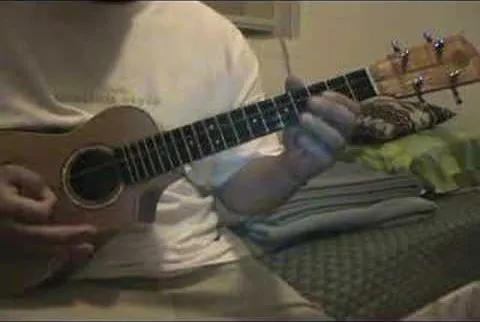
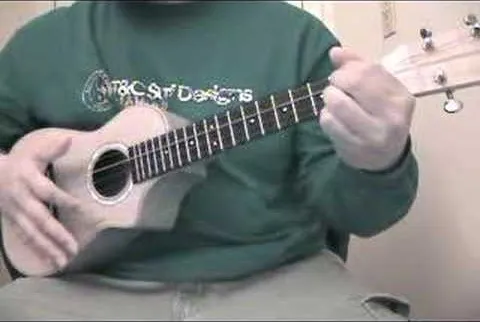
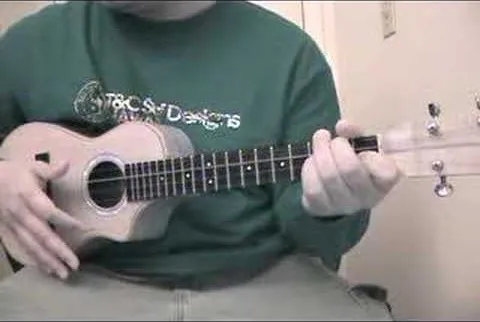
Learn how to play "Wipeout" on the ukulele! This is an EXCELLENT, slow tutorial. This song sounds better--and more tropical--on the uke than on the guitar
Learn how to chime on the ukulele! It's really easy! You can chime on the fifth fret on the bar. You don't actually put pressure on the strings. Watch the video to learn more.
Learn how to play the basic ukulele chord progression in "G"! Play G, E minor, C, and D7 (or you can substitute E minor with B minor). No, it doesn't sound too sad, just a little wistful.
Watch this video to learn how to play the ukulele chord progression in "C"! Start with C, A minor, F, and G7. Or try C, F, C, and G7. Or C, F, C, and G7. You'll get the hang of it.
Check out this video to learn how to play the 7th chords on the ukulele. This includes A7, B7, C7, D7, E7, F7, and G7. A7 is pretty easy to play, just use your pointer finger on one string (watch to see what string!)
Check out this video to learn how to play the minor chords on the ukulele! Play A minor, B minor, C minor, D minor, E minor, F minor (my favorite), and G minor.
This is a great video for learning how to play one the most awesome songs in history - Sweet Child O' Mine from Guns N' Roses. It shows you nice and slow the proper finger placement.
Want to learn how to play the trumpet? Here is a good place to start. Using embouchure, you will be a master. You will also learn how to assemble the trumpet and use your slides.
In this section, Chris Traylor teaches you how to play open hi-hat shuffles on your drums. Shuffle your way along to success. Or just keep it a hobby that you never share with anybody. It's your call.
In this section, Chris Traylor continues to share pointers on different hi hat techniques for playing the drums. Pull out a fresh pair of drum sticks and get ready to rock, or just suck (hopefully not the latter).
Are you ready to rock? In this section, Chris Traylor guides you through different hi hat techniques for your drum kit. Make sure your foot doesn't ache, cause you're going to need it for this.
What is a drum fill? Simply put, it is a short rhythmic idea played by the drummer to fill a space at the end of a vocal or instrumental phrase. All you need is a drum kit with a snare drum, and you're set. Just don't steal it, please.
In percussion, the paradiddle is a four-note pattern of the form RLRR or LRLL. When multiple paradiddles are played in succession, the first note always alternates between right and left. Paradiddles. Isn't that a funny word? It's reason enough to watch this.
Learn how to close the hi-hat while playing the cowbell pedal with your heel. Alan Schechner will show you how to do it. Or you can just find a cow with a bell on it, and hit it. But this will probably be better.
Learn about some alternative stick ideas to use when playing the drums. Rather than using a traditional drumstick, you can try one of these examples! Alan Schechner shows you the tricks. He does not lie. Take his advice. You won't regret it.
Learn how to play transformations in odd time signatures on the drums. Alan Schechner will teach you how to master your dreams of drumming mastery, just don't wet your pants watching him play.
In this Make Magazine podcast Bre Pettis makes a theremin from a kit by Harrison Instruments. A theremin is a super cool musical instrument invented in Russia in 1918.
Charles Sedlak shows you how to add a little more flavor and personality to your pentatonic scale, for that electric blues guitar you have sitting at home, collecting dust. Some break out the Pledge, and play along.
Charles Sedlak shows you to properly tune your guitar in order to play Flamenco. You're just minutes away from playing this Spanish style music, and you can have your girlfriend dance on the table while you pluck those strings.
Charles Sedlak shows you how to exercise your blues skills and improve your playing technique. Play along with these riffs to master your abilities. But just so you know, you might want to know how to read tabs, or you might as well forget it.
Charles Sedlak demonstrates the difference between legato and staccato notes when playing blues on your electric guitar. Every one should learn this, so don't say 'you don't need it'.
These techniques are important for playing any type of solo - here Charles Sedlak will show you how to do hammer-ons and pull-offs. And no, you don't actually need a hammer for this, and if you thought so, stop playing right now, put it down - you don't deserve that guitar of yours.
Blues isn't just about what you play, but how you play it. Here, Charles Sedlak shows you how to style your blues playing with vibrato techniques. Feel those strings, personally, for perfect bend pitches. Even the pros screw this thing up.
Charles Sedlak shows you the pentatonic blues scale, consisting of five notes. You definitely need to know these, if you want to hit some awesome riffs.
Charles Sedlak shows you how to master the 12-bar blues and a moveable 12-bar pattern. We will begin in the key of G. Pay attention and you'll never need another lesson, ever again (just kidding, you'll need more, much, much more).
Charles Sedlak shows you the Rumba Blues - a great tune to spice up your playing using a hammer-on! You say you don't need any spicing up, but nobody believes you. Watch the lesson, please, for everybody's sake.
Charles Sedlak shows you 'blues buffs' how to properly tune your guitar for a perfect blues experience. You already know how? Fine, then don't watch. But you'll be missing out.
Charles Sedlak shows you a different form of Arpeggio to style your Flamenco playing with an acoustic guitar. If you get this down, you will really impress. That's what you want to do, right?
Charles Sedlak teaches you about three strokes and Arpeggio techniques for playing Flamenco. Learn how to play these chords, single note at a time. The strings will love you for this.
Don't get frustrated, this technique isn't that easy! Charles Sedlak shows you how to perform Flamenco triplets on your guitar. Take your time, it's nothing to kill yourself over. If so, then you shouldn't be a musician.
Charles Sedlak shows you one of the most fun strumming techniques in Flamenco - the Rumba. You won't be able to stop playing this Spanish style music. It's so addicting, like crack, but how would I know.
Charles Sedlak explains how to score that muted tone on your acoustic guitar. Just touch your palm against the strings. It's a little tricky, but you can figure it out, I'm sure of it.
Charles Sedlak shows you how work on your blues progressions on an acoustic guitar. We'll begin with two strings at a time. Power chords and blues go together like sugar and coffee. You just have to perfect them.
Charles Sedlak shows you how to use your fingers for picking strings on your acoustic guitar. A great change when you're without a pick! Do you really need a guitar pick anyways? It's a choice, with or without, but most like without.
Charles Sedlak shows you how to style your acoustic guitar playing with the help of accents. Accenting is easy and keeps your music from sounding like a machine. Just nice and soft, don't overwork those strings.
Learn how to play a D Add F Sharp on your acoustic guitar with Charles Sedlak. What more could you want? A record deal? Maybe you should slow down a bit, and learn the basics, no? Have you even popped a string yet? I didn't think so.
Learn how to do a note-strum with Charles Sedlak, picking a note and then strumming. This style is popular in country music and allows for a versatile twang. Soon, you'll be strumming those strings in front of a large crowd, or just a little one, or maybe just your mother. Good luck.
Learn how to perfect that upstrum and ghost-strum on your acoustic guitar with Charles Sedlak. What's a ghost-strum? Why don't you stop asking questions and just watch and see for yourself?
Learn how to easily skim those strings with constant right-hand movement, from Charles Sedlak! Soon that acoustic guitar will seem like your were born with it. A little strumming goes a long way to success.
Learn how to switch chords smoothly on the acoustic guitar as Charles Sedlak teaches you! By using a metronome, you'll see how easy it can be to get your instrument in tune and on pace with your music.
Learn a better way of using those fingers on the strings for playing the G7 chord on your acoustic guitar. You will not believe your eyes, or your ears! Charles Sedlak shows you how.